
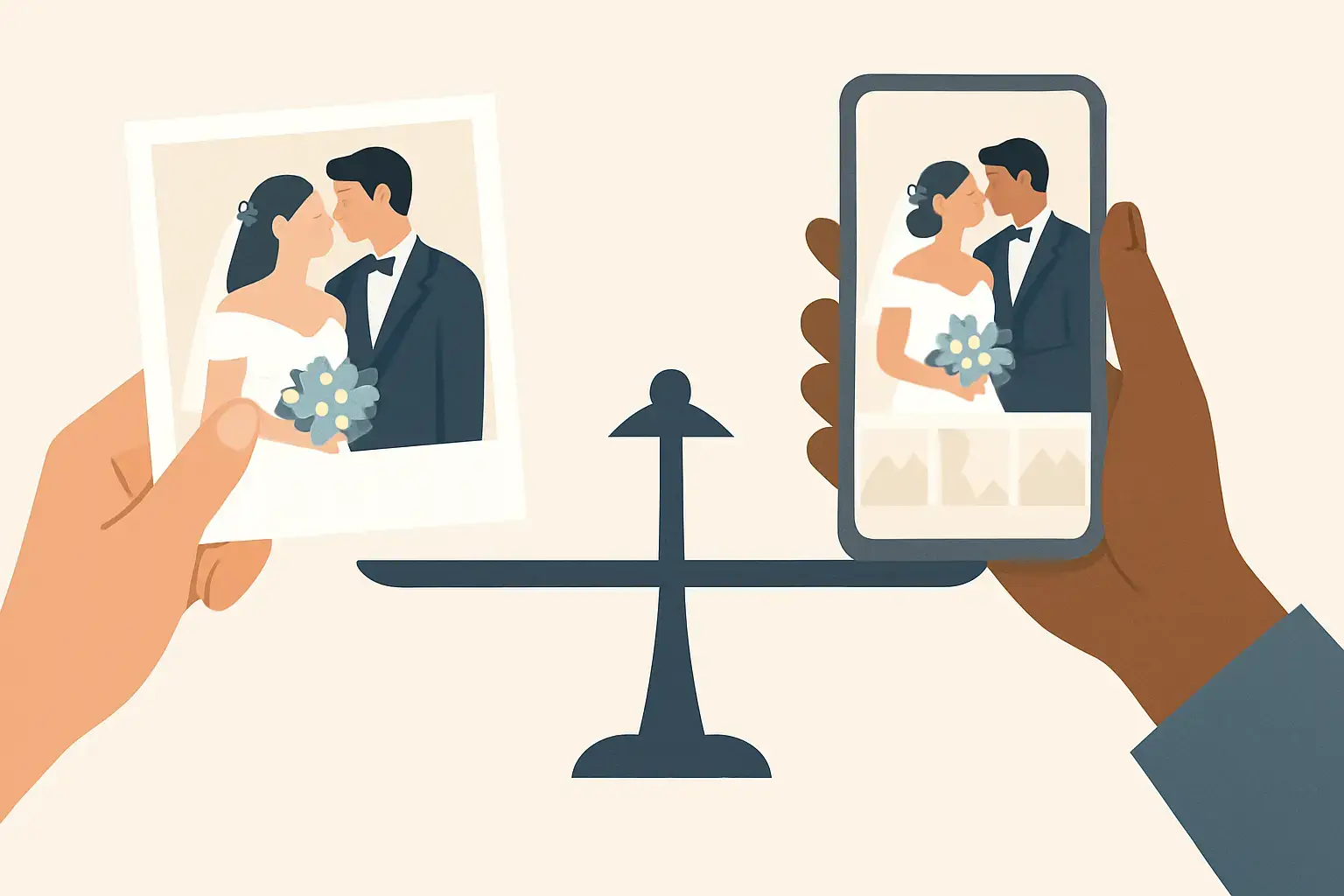
You know the moment: your friend grabs your hand, drags you toward the booth, and suddenly you are laughing so hard you forget your posture. Two minutes later, you are holding proof it happened – or you are waiting for a link that will land in your inbox sometime after dessert.
That tiny difference changes how your guests experience the memory. So when couples ask us about printed photos vs digital gallery, it is rarely a technical question. It is a feeling question. Do you want your wedding to leave the room with your guests in their hands, or live instantly on their phones, or both?
Printed photos vs digital gallery: the real difference is momentum
Printed photos create momentum in the room. People walk back to their tables holding strips or postcards, showing them to friends, taping them into the guest book, or slipping them into a clutch like a little secret. Prints turn a photo into an object, and objects get passed around. That is why prints can quietly increase participation – guests see them everywhere and think, “Wait, we need one too.”
A digital gallery creates momentum online. Your guests post to Instagram Stories, send group chats an instant recap, and tag friends who could not make it. Digital is social in the literal sense: it spreads fast, and it keeps spreading after the last song.
Neither is “better.” They simply energize different parts of the experience – the room, the internet, and your future self.
Why printed photos still feel like magic
Prints work because they feel scarce. A photo on a phone is one of thousands. A printed photo is one of a few – and it carries the night with it.
There is also a design advantage couples sometimes forget: a print can be styled to match your wedding. The font, the frame, the layout, even the vibe of a glossy postcard versus a classic strip – it all becomes part of your aesthetic. When the design is on point, the print looks like it belongs on your tables, not like an afterthought.
And then there is the guest book factor. If you are doing a guest book, prints make it effortless. Guests take a photo, stick it in, and write the message while the emotion is fresh. A digital-only setup can still work with a guest book, but it usually relies on someone doing follow-up printing later, and that is where good intentions go to die.
Prints also have a quiet superpower for multi-generational weddings. Not everyone wants to scan a QR code or find an email later. Grandma understands a photo in her hand.
Where digital galleries win, every time
Digital galleries are unbeatable for speed and reach. If you want your wedding to feel like it is happening in real time for friends and family who could not attend, digital delivery is the move. Guests can share within seconds, and you get instant buzz while the dance floor is still full.
Digital also gives you volume. If your guests are taking multiple takes, switching groups, filming quick clips, or capturing 360 moments, a digital gallery keeps that flood of content organized and accessible. It is also easier to back up, duplicate, and store, which matters when you are thinking long-term.
And for couples who love a clean look – no prints on tables, no stacks at the booth, no stray strips left behind – digital keeps the experience sleek.
The trade-offs you actually feel on event day
Prints can disappear faster than you expect
If you are doing prints, assume guests will take them. That is the point, but it can surprise couples who imagined collecting extras later. If you want a set for yourselves, plan for it. Many couples choose a print setup that allows more than one copy per session so guests get theirs and you still have a version for your own keepsake box.
Digital can feel “later,” even when it is instant
Even with quick text or email delivery, digital has a tendency to become tomorrow’s problem. Guests get the link and think, “Cute, I will download it later.” Later turns into never. The photo still exists, but it is not living anywhere special.
The fix is not complicated: make the digital moment feel immediate. Encourage guests to post that night. Create a sign with your hashtag. Or pair digital with one physical touchpoint – even a few prints for the guest book – so the memory is anchored in the room.
Prints create physical clutter, digital creates digital clutter
Prints can end up on tables or tucked into suit pockets and forgotten until laundry day. Digital files can get buried in camera rolls and old texts. Either way, the real question is: which type of clutter is your crowd more likely to turn into a keepsake?
What to choose based on your wedding style
If your wedding is romantic, classic, and detail-driven, prints tend to match the mood. They feel timeless, and they look beautiful in flat-lays, on memory boards, and in albums. A photo strip tucked into a thank-you card later also feels deeply personal.
If your wedding is high-energy, modern, and social-first, a digital gallery fits naturally. Your guests are already in content mode. They want the video, the boomerang energy, the instant share.
If you are hosting a mixed crowd, you do not have to pick a side. A hybrid approach is often the sweet spot: prints for the people who want something tangible, and digital delivery for everyone who wants to post before the cake is cut.
A simple way to decide: what do you want guests to do next?
Ask yourself what you want to happen after they step away from the booth.
If you want them to walk back to the table showing everyone their photo, go with prints.
If you want them to pull out their phone and share right away, go with digital.
If you want both behaviours, build both into the plan.
That one question cuts through a lot of overthinking.
Longevity: which one will you still have in 10 years?
A print can fade or get lost, but the best ones survive because they are visible. They end up in frames, albums, and drawers you actually open. They are rediscovered during moves, anniversaries, and Sunday clean-ups.
Digital files can last forever, but only if they are managed. The truth is that phones get replaced, links expire, and forgotten folders stay forgotten. Digital longevity is less about the format and more about your habits.
If you choose digital, make a plan you will actually follow: download your favourites within a week, back them up, and put the best ones somewhere you will see them – a shared album, a printed mini book later, or even one framed print from the night.
Cost and value: what you are really paying for
People assume prints always cost more. Sometimes they do, because you are paying for physical materials and on-site production. But value is not just cost – it is impact.
Prints can increase guest participation because they are visible and collectible. That can make the booth feel like a bigger part of the night, not just a corner activity.
Digital can increase sharing, which can make your wedding feel bigger than the room. If you care about that social ripple, digital has a value that is hard to replicate with paper.
If you are watching budget, think about where you want the “wow” to land: on the tables and in hands, or on screens and feeds.
How your venue shapes the print vs. digital decision
The venue’s vibe often tips the balance. At heritage venues like LIUNA Station in Hamilton and the Stone Mill Ballroom in St. Catharines, physical prints feel like they belong — guests hold them alongside the architecture and it all feels cohesive. At modern venues like White Oaks Resort in Niagara-on-the-Lake, digital galleries with instant text delivery match the sleek, tech-forward atmosphere. Vineyard weddings at Ravine Vineyard work beautifully with both — metallic prints displayed on the barrel cellar tables as favours, plus a digital gallery link texted out so guests can share online. For large-scale events at the Burlington Convention Centre with 500+ attendees, digital delivery is the practical choice to keep the booth moving without a print queue backing up.
The most popular choice: do both, on purpose
Hybrid setups work best when they are intentional. Prints should not be an afterthought and digital should not be “whatever happens.” Design the print template to match your wedding look, and set up digital delivery so it is truly easy for guests.
This is also where a photography-first booth experience matters. When the lighting, composition, and capture quality are dialed in, both formats shine. The print looks premium, and the digital file looks good on a phone screen without needing a filter to save it.
If you are planning a Niagara wedding and want a booth setup that delivers that kind of polished, shareable keepsake energy, Pic Booth can help you match the right experience – prints, digital, or a curated blend – to your venue, your timeline, and your crowd.
The decision you will never regret
Pick the format that matches how you want your wedding to be remembered, not how you think you are “supposed” to do it. Some couples want a stack of prints that feels like proof of a night well lived. Others want a gallery that lights up their phones before the last call.
If you are torn, choose the option that makes it easiest for your guests to keep the memory close. Because the best keepsakes are not the ones with the highest resolution – they are the ones people actually come back to.