
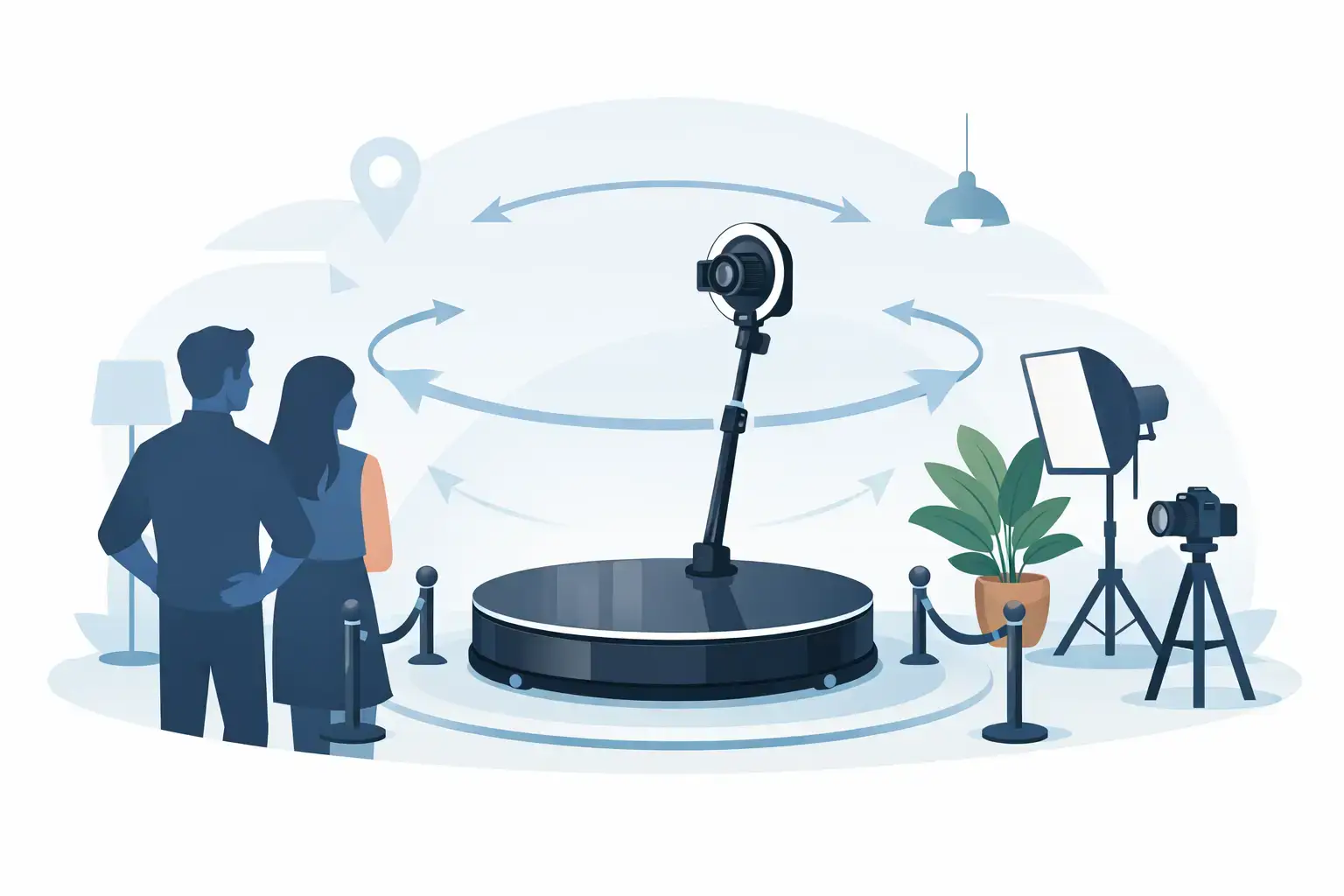
A 360 booth looks incredible in a highlight reel, but it needs more room than most couples and hosts expect. If you’re wondering how much space for 360 booth planning, the short answer is this: most events should allow at least an 8×8-foot area, and often closer to 10×10 feet for a polished, stress-free setup.
That extra breathing room matters. A 360 booth is not just a platform – it is a full experience with a rotating arm, guests stepping on and off, a backdrop or open visual space, lighting, and a small crowd gathering to watch the fun. When the footprint is too tight, the videos can feel cramped and the guest flow gets awkward fast.
How much space for 360 booth setups really need
For most weddings, galas, and private events, a 360 booth works best in a minimum 8×8-foot space. That is usually enough room for the booth platform, the rotating arm, safe clearance around the equipment, and guests entering and exiting comfortably.
That said, minimum does not always mean ideal. If you want the booth to feel premium, photograph beautifully, and avoid congestion, 10×10 feet is often the better target. This gives the setup room to breathe and helps guests enjoy the moment instead of feeling packed into a corner.
Larger groups need more. If you expect friends to jump on together, dramatic dresses, or guests who love to pose with props and movement, you may want 10×12 feet or more. A bigger space is especially helpful at weddings, where formal wear changes how people move. A fitted cocktail event setup and a black-tie reception setup can technically use the same booth, but they do not use the space the same way.
The space around the booth matters as much as the booth itself
A common planning mistake is measuring only the platform. The full 360 experience includes the working area around it.
The rotating camera arm needs clear movement. Guests need room to step up, pose, turn, and step down without bumping into chairs, walls, floral installations, or nearby decor. Your attendant also needs enough access to guide guests and keep the line moving.
Then there is the audience factor. People love watching a 360 booth in action. It naturally draws a crowd because it feels like live entertainment, not just a photo station. If the booth is squeezed beside a dinner table or jammed near a bar lineup, you can end up with traffic problems all night.
This is why booth placement usually works best in an area with natural flow but not constant interruption. Near the dance floor can be fantastic because it keeps the energy high, but too close to the DJ speakers or a packed entrance can make it harder for guests to hear instructions and move safely.
Ceiling height and overhead clearance
Floor space gets most of the attention, but ceiling height matters too. A 360 booth setup generally needs a standard event ceiling to operate comfortably, especially when lighting and camera angles are part of the final look.
As a safe baseline, aim for at least 8 feet of ceiling clearance. More is better. Ballrooms and reception venues usually have no issue here, but low basements, tented spaces, or rooms with hanging installations can create problems.
Chandeliers, low decor, hanging greenery, and exposed beams are all worth flagging early. Even if the booth physically fits on the floor, overhead obstacles can limit where it can be placed or affect the quality of the final video.
Indoor vs outdoor space requirements
Indoor events usually make space planning easier because the floor is level and the booth team can control the environment. In a banquet hall or wedding venue, it is simpler to mark out a clean square and build the setup into the room design.
Outdoor events can absolutely work, but they need more thought. Uneven ground, grass, heat, wind, and weather backup plans all affect placement. In many outdoor cases, it is wise to allow a little more than the minimum footprint so the team has flexibility to create a stable, guest-friendly setup.
If your event is under a tent, treat the tent posts and sidewalls like part of the layout challenge. What looks roomy on paper can shrink quickly once furniture, catering stations, and structural poles are in place.
Guest count changes the answer
If you are planning an intimate wedding with 60 guests, your 360 booth can often live happily in a smaller dedicated corner, provided there is still room for a short lineup. If you are hosting 200-plus guests, the issue is not just whether the booth fits – it is whether the experience fits.
Higher guest counts usually mean longer lineups, more onlookers, and more pressure on the surrounding space. In that case, it helps to give the booth a larger zone around it so the excitement feels organized instead of chaotic.
This is one of those it-depends moments. A compact footprint may be technically possible, but if your goal is extraordinary guest energy and shareable videos all night, a little more space often delivers a much better result.
How layout affects the final video
A 360 booth is part entertainment, part content creation. The room around it shapes what the final clip feels like.
When the booth is boxed into a tight area, you often see visual clutter in the background – stacked chairs, venue service doors, guests cutting through the frame, or half-hidden decor. When it has the right amount of space, the experience feels more intentional. Guests can move naturally, outfits have room to shine, and the finished video looks elevated.
That matters even more at weddings, where every detail has been chosen for a reason. If you have invested in florals, lighting, signage, and a beautiful room design, the booth should complement that atmosphere rather than compete with it.
Best places to put a 360 booth at an event
The strongest booth locations usually have three things: visibility, open clearance, and enough distance from major bottlenecks.
A spot just off the dance floor can be perfect because it keeps the booth connected to the energy of the night. A foyer or cocktail area can also work well if it is wide enough and not being used for guest arrival rushes. In some venues, a side section of the reception room gives the best balance – easy to find, but not in the way.
The least ideal placements are usually beside dining tables, directly in a main exit path, or tucked into a cramped corner where the rotating arm and guest movement feel restricted. A 360 booth should feel like a feature, not an afterthought.
360 booth spacing at Ontario’s top venues
We’ve mapped the 360 booth footprint at venues across the region. At Club Roma in St. Catharines, the main ballroom gives us a 12-foot radius with no obstructions — plenty of room for the standard platform and rotating arm. LIUNA Station in Hamilton has wide-open floor space in the grand hall but lower clearance in the cocktail lobby, so we always set up in the main room. At White Oaks Resort in Niagara, the modular event walls let us claim a dedicated corner that doesn’t encroach on the dining area. Ball’s Falls Conservation Area requires a flat patch of ground and we bring levelling pads for the uneven terrain. At Paradise Banquet Hall in Vaughan and Embassy Grand in Brampton, the large open floor plans handle the 360 setup easily alongside other entertainment stations.
Questions to ask your venue before booking
Before finalizing your layout, ask your venue for the actual dimensions of the area you are considering. Ask whether there are floor plan restrictions, ceiling obstacles, power access, or rules about where entertainment can be placed.
It also helps to ask what else will share that space. A booth that looks fine on an empty floor plan can become tight once you add a sweetheart table, gift table, dessert station, or band equipment.
If you are working with a full-service team, this is where consultation makes a big difference. A professional provider can assess the room, spot issues early, and recommend the best placement so the booth performs beautifully on event day. At Pic Booth, that planning mindset is part of creating the kind of polished, photography-first experience couples and hosts actually remember.
So, what is the ideal amount of space?
If you want the simplest answer to how much space for 360 booth planning, use this:
An 8×8-foot area is the practical minimum, 10×10 feet is the sweet spot for most premium events, and anything larger can be worth it for big guest counts, larger group shots, or more comfortable traffic flow.
If your venue is tight, the booth may still work, but the trade-off is usually guest movement, line management, or the overall visual feel. If your venue is spacious, giving the booth proper room helps it become the kind of high-energy moment people talk about long after the last dance.
When you are planning a wedding or celebration, the goal is not simply to make the booth fit. It is to give it enough space to create magic without competing with everything else you have worked so hard to design.